Planned to the Minute at Toronto’s Union Station
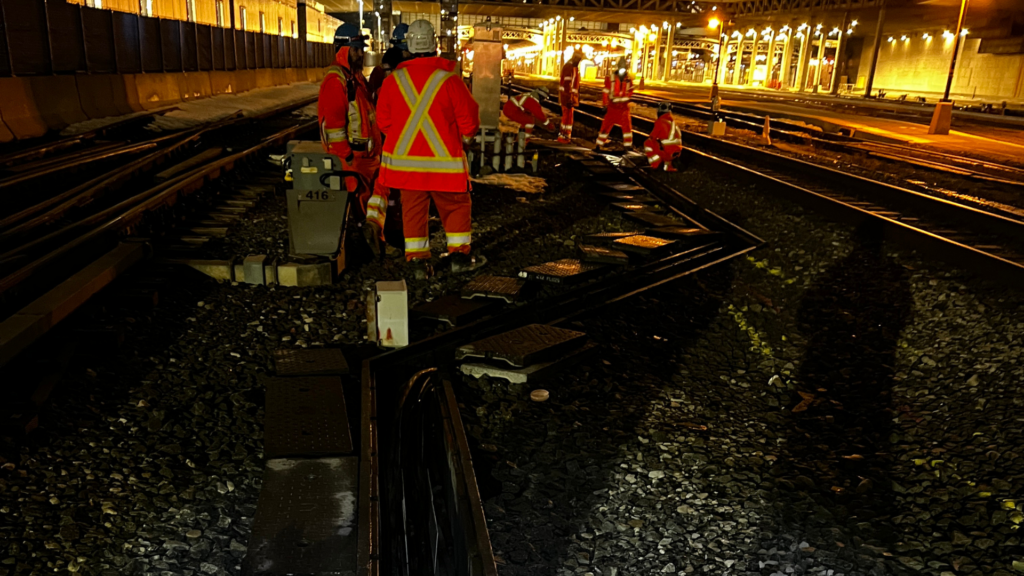
At 1 a.m., when the last train clears Toronto’s Union Station, one of the busiest rail hubs in North America, Majed Abubreik and his crew put months of planning into motion.
As signal superintendent for Mass. Electric Construction Co., a Kiewit subsidiary, he and his team of five people have until 5 a.m. to remove, reroute and rebuild critical signalling infrastructure before everything must be back online to avoid disrupting train service.
“Every activity is mapped out hour-by-hour before we even step on the jobsite,” Abubreik said.
This work is part of the Union Station Enhancement Project — a project that will support the creation of a network that has the capacity to deliver two-way, all-day rail service every 15 minutes or better along core segments of the GO network.
This includes improving platforms, building a new concourse and modernizing the entire signalling system along the Union Station Rail Corridor, which includes 6.4 kilometers of tracks.
Abubreik and his team are responsible for removing legacy signal power and communication systems, installing new cable routes and reconfiguring active signals that trains rely on every day. Much of the system dates back to 1929, requiring crews to integrate this technology with modern infrastructure.
“Finding parts is one of the biggest challenges,” Abubreik said. “We’re also trying to make new systems communicate with old ones, which can create compatibility issues.”
The team works in coordination with Kiewit’s civil crews, who are building the new concourse and platforms above and around the signaling work.
“Everything is connected. If we get delayed, it impacts the excavation and the rest of the project,” he said.
One recent milestone involved transitioning multiple active signals to newly installed infrastructure within an active construction zone. The cutover happened in April 2026, but planning for it began in December 2025.
Even with careful preparation, conditions can change quickly. Late trains or special events can shorten the available work window.
“I’ve seen nights where we don’t get access until 3 a.m. and still have to clear by 4:30,” he said.
However, the advanced coordination helps the MEC crew stay ready to adjust while keeping the work moving.
“It’s rewarding,” Abubreik said. “When you see that preparation come together and works the way it should, it’s a big win for the team.”
The upgraded signaling system will improve reliability and enable more frequent service for customers in the future.
“I’m fortunate to have my crew,” he said. “They’re knowledgeable and they want to be productive. Everyone is focused on getting the job done.”
Read more about the project here.