
From Ground to Go: Project Startup Built for Speed At Scale
July 17, 2026
Across Kiewit, project mobilization is not a single step. It is a continuous effort that aligns equipment, materials and people so work can begin without delay. That effort spans the entire company, with projects at every stage, from early planning to active mobilization to closeout, all moving forward at once.
And it begins well before local mobilization — during the estimate and often before the contract is executed.
“That’s where we’re aligning materials, logistics and site needs so that when the job is awarded, everything moves quickly,” said Colin McKernan, president of Kiewit Supply Network (KSN), which manages the movement of materials and logistics across projects.
The goal is simple: remove the noise of mobilization so teams can focus on the work itself.
“At that scale, that coordination allows us to stand up a project quickly and focus on planning the work with limited distractions so our teams can deliver for the client from day one,” said McKernan.
In another corner of the company, the same level of planning goes into dispatching Kiewit’s massive equipment fleet.
“We have a corporate schedule with start and end dates for all the equipment assets we have in the company,” said Steve Curry, vice president of Kiewit Equipment Services.
Equipment teams work with estimating and construction to match project needs with available fleet or identify alternatives such as rentals and subcontractors.
“If specialized equipment is needed, lead times are critical, so the longer we have to evaluate options and make decisions, the better chance we have of being able to fulfill the project needs on time,” Curry said.
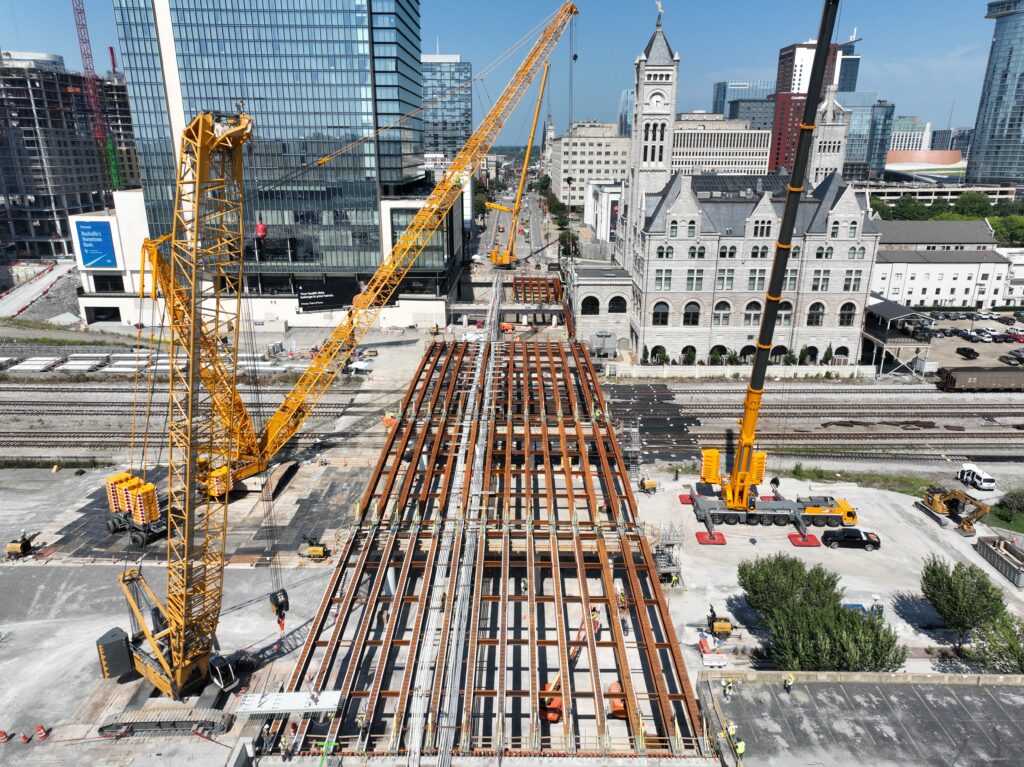
That level of planning shows up in execution. On the Broadway Bridge job in Nashville, crews had a limited window for crane lifts over an active rail line, requiring equipment to be staged, ready and removed on a precise schedule.
“All the planning and execution — loading, assembly, disassembly — that’s all done by Kiewit people. It allows us to control our destiny.”
That control helps Kiewit stay on track with cost and schedule. Back at KSN, Mark Studer focuses on a single moment of the next project: when all those boots start hitting the ground.
For Studer, it starts with one question: “When do you need your trailers ready so you can go to work?” From there, the team works backward. That planning can begin as early as six months out.
Everything is timed and sequenced to meet the needs of the job team, from electrical and plumbing to office furniture and site services such as IT infrastructure and connectivity, trash, cleaning, coffee and water.
Even basic site services can become complex depending on location, weather and site conditions, requiring the right sizing, reliable vendors and systems that keep up with the work.
It’s about thinking ahead to what could impact execution and building the right setup from the start, ensuring those behind-the-scenes details don’t become distractions for the project team once crews are on site.
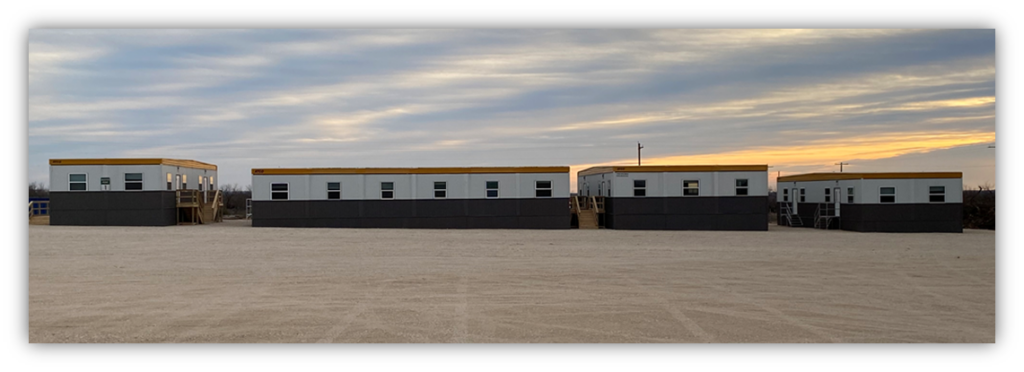
Over the past three years, the workload has only accelerated. In 2025 alone, Studer’s team supported 42 projects across the company, with demand for megaprojects (projects exceeding $1 billion) continuing to grow.
That work spans a wide range of jobs, from the redevelopment of the former Homer City Generating Station in Pennsylvania, a 3,200-acre site being transformed into a new energy campus, to mega data center campuses supporting the rapid growth of artificial intelligence and cloud infrastructure like at Project Frontier — a multi-billion-dollar, 3.7 million-square-foot data center in Shackelford County, Texas. Studer says Project Frontier’s campus alone is expected to approach 400 trailer units.
What began as an effort with Kiewit’s energy market projects has proven both scalable and effective, now supporting projects across all markets where it adds value.
Take a recent infrastructure job down in Fort Lauderdale, Florida, for example. The Prospect Lake Clean Water Center is a major water treatment facility designed to deliver 50 million gallons of drinking water per day. There, coordination has already proven successful, with KSN supporting full site readiness.
“None of it happens without the people in place to build it,” said Alyson Manning, vice president of Human Resources.
Kiewit’s human resources teams are also engaged early, working with project leaders to understand staffing needs, timing and how teams ramp up over the life of the job.
“It comes down to having the right people in place at the right time,” said Manning.
For clients, that means experienced teams are in place when the work begins. For employees, it creates opportunity.
“You get exposed to different types of work, different places and different teams, and that experience helps you grow in ways you wouldn’t otherwise,” Manning said.
In 2025, Kiewit supported more than 4,200 craft transfers and over 3,100 employee moves across 184 projects, aligning people to work across eight markets.
“It takes discipline — getting everyone in a room and understanding who goes where and when,” she said.
It’s that discipline that allows Kiewit to move from ground to go — at scale, on every project, every time.