Protecting What Lies Below
April 27, 2026
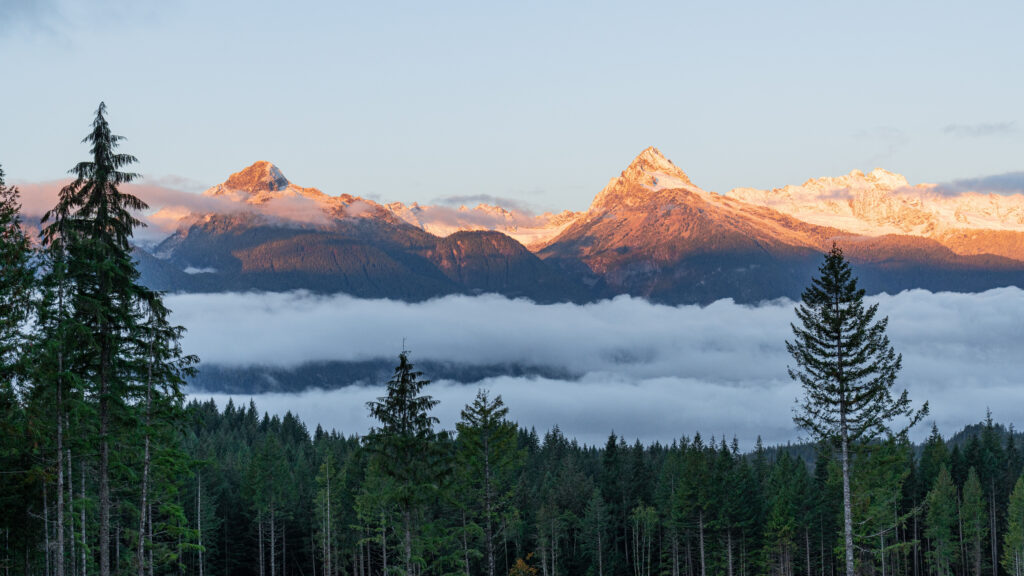
Near the base of Nch’kay’, or Mount Garibaldi, the Squamish community, in western Canada, has lived for decades with the threat of large debris flows. These fast-moving surges of mud, water, trees and boulders can cascade down the river with little warning. The Cheekye River, whose name comes from the Skwxwú7mesh (Squamish Nation language) word for “muddy waters,” has a long history of these events.
Because of the historical risk, development on the alluvial fan — the broad deposit of sediment formed where the river spreads out at the base of the mountain — had been restricted for years. Despite many existing homes and businesses on the fan being in harm’s way, little had been done to reduce the risk. Sqomish Sea to Sky Developments, a partnership between the Squamish Nation and local land development company Matthews West, owns just over 500 acres of this land.
“The land has been slated for development since the early 1980s but has been restricted until the debris flow hazard can be adequately managed. Existing homes, businesses, parks and other infrastructure surround the land and will also benefit from the project,” said Jenni Chancey, senior project manager at Matthews West.
Initial development plans include building housing and supporting infrastructure. Doing so safely required a solution capable of withstanding a one-in-10,000-year debris flow event.
The Sqomish Sea to Sky Developments team spent more than a decade studying the hazard to identify a viable path forward for future development.
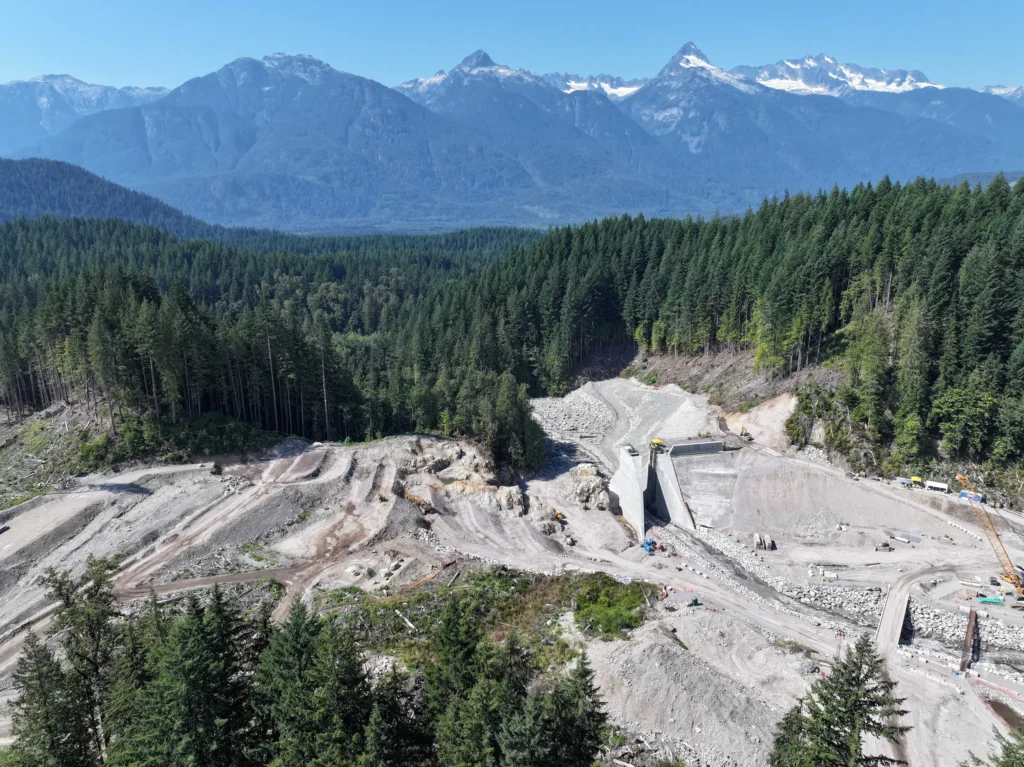
The result is a one-of-a-kind barrier, designed by BGC Engineering (BGC), anchored to a natural rock outcrop high in the mountains. While hidden from the communities below, the Cheekeye Debris Flow Barrier will play a crucial role in protecting them.
Partnering and planning
Kiewit Construction Services ULC joined the effort in 2019 to support project development, assess constructability of BGC’s designs and help determine what it would take to build such an unusual structure and innovative design in challenging terrain. Jesi Neill, Kiewit project sponsor, has been part of the project since that early phase. That early involvement proved essential as the project took shape.
The Cheekye River is an important part of the surrounding ecosystem, connecting to high-value fish-bearing habitats downstream. The designers needed to provide a solution that would reduce debris flow risk while maintaining environmental integrity, preserving the river’s natural behaviour and minimizing long-term impacts.
The barrier stands 27 metres tall and includes a controlled slot designed to function only during large debris flow events.
“The slot down the middle of the structure is designed to allow the river and small-scale debris to pass through but blocks the catastrophic debris events that would be harmful to humans and infrastructure downstream,” said Neill.
Self-performed solutions
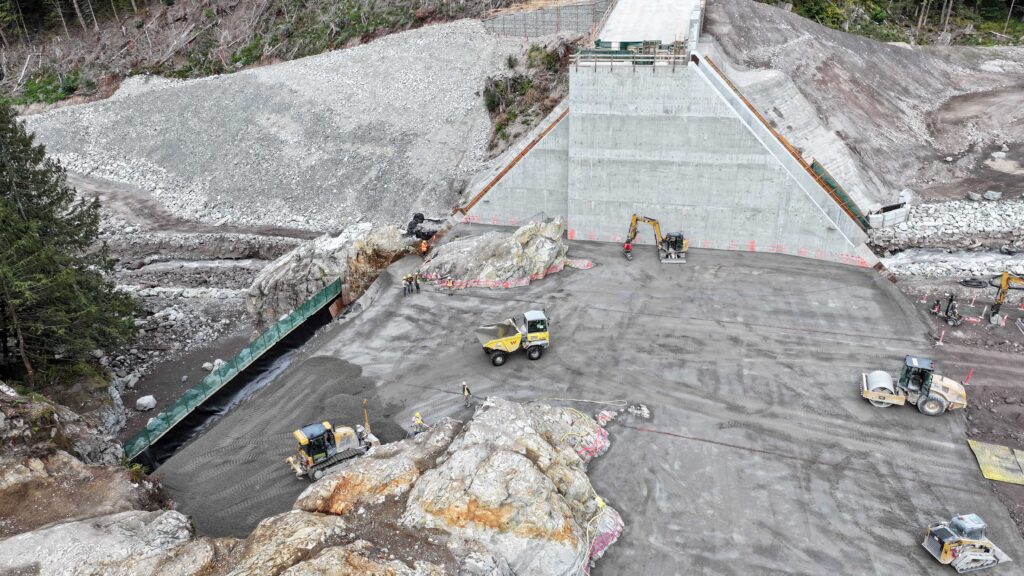
On either side of the slot, large abutments made from 53,500 cubic metres of roller-compacted concrete (RCC) support the structure. RCC is a dry concrete mix that is batched, placed in lifts and compacted with heavy equipment.
To support construction in the remote environment, Kiewit crushed RCC aggregate on site and batched both traditional concrete and RCC using an on-site plant.
“We chose to set up a batch plant on site because hauling concrete up the mountain roads in the winter would be challenging,” Neill said. “This allowed us to continue working through the winter without shutting down.”
This approach also reduced deliveries along a heavily used mountain biking corridor, minimizing disruption to the surrounding community and reducing the project’s overall environmental footprint.
RCC refined
From early design through construction, the Kiewit team provided construction-focused input to BGC to refine the RCC plan.
We wanted to challenge the status quo on mix designs, placement techniques and equipment,” said James Goggans, Kiewit planning manager.
That collaboration led to several innovations. One involved using a skid-steer brush attachment to green-cut RCC lifts, replacing the traditional water-based method. The change eliminated runoff concerns and further protected the river running through the site.
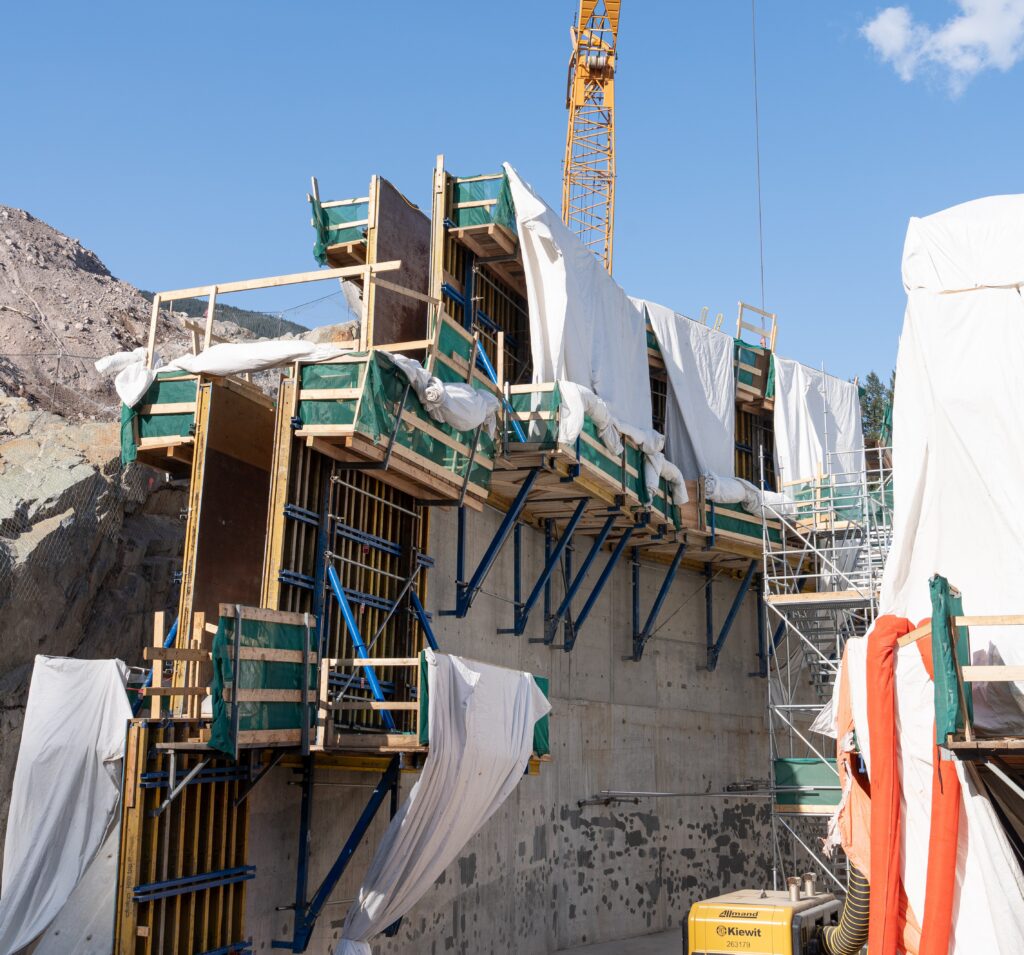
Another innovation adopted a concept used on Kiewit’s work at Oroville Dam in California, replacing traditional formwork with mechanically stabilized earth-style wire baskets to create vertical RCC faces. The approach improved safety by eliminating the need to set forms on steep slopes and increased production efficiency.
“These are techniques our people will take into future projects,” Goggans said. “Many of our staff and craft are leaving this project with RCC experience that will be essential going forward.”
A project that built people
Beyond RCC experience, the project gave team members exposure across a wide range of disciplines.
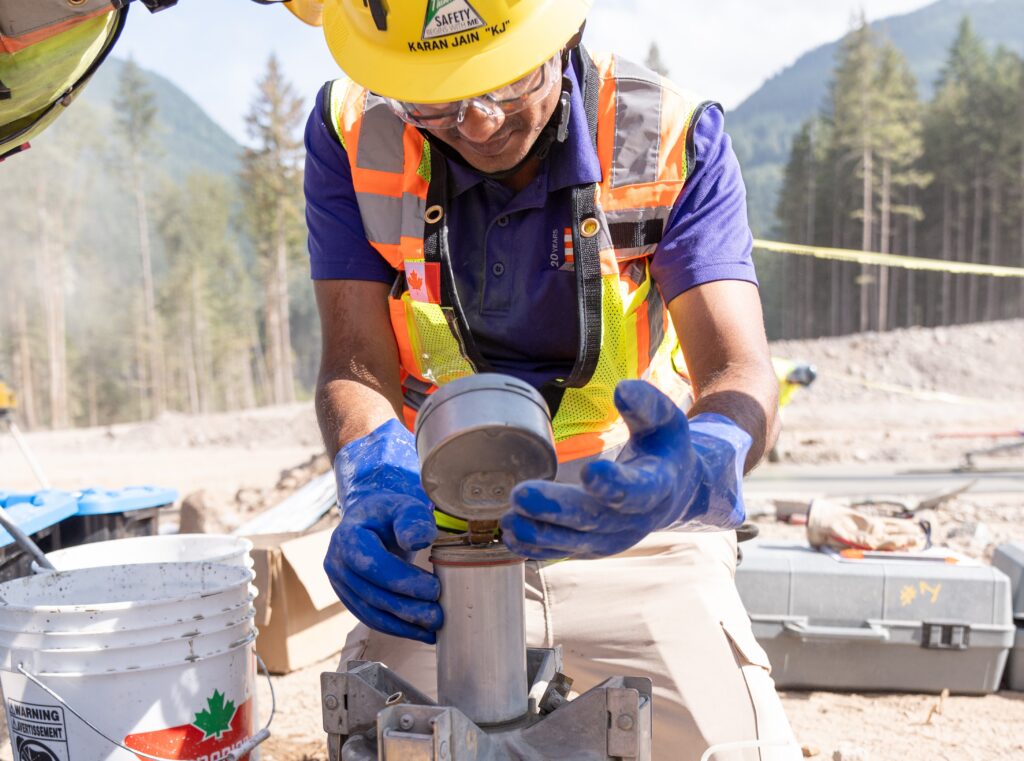
“The team had the opportunity to be exposed to earthworks, drill and shoot, crushing, river diversions, concrete forming, rebar, concrete batching and pouring, RCC batching and placement, surveying, QC testing and reclamation,” said Goggans.
Neill said that people development was one of the most rewarding aspects of the project.
“One of the best parts of the job was being able to develop so many great people,” she said. “Whether that means our field engineers growing into first-time superintendents and project engineers or developing superintendents into construction managers.”
That leadership approach did not go unnoticed. Neill was nominated for the 2025 Peter Kiewit Excellence in Management Award, the company’s highest internal recognition for project management.
Building where the mountain still moves
Constructing the barrier required constant awareness of the environment. The site sits in an active debris flow path, and the team experienced three debris flow events during construction.
“When you’re working in a debris flow path, your diligence to safety protocols is essential,” Neill said.
The team monitored weather, mountain conditions and river activity. Cameras and specialized alarm systems provided immediate evacuation alerts when conditions changed.
“We put significant focus on emergency evacuation protocols on the project, and to date, there have been no issues during any evacuation alerts,” Neill said.
The construction of this barrier also required a two-phased river diversion so crews could build each section of the barrier safely. A key milestone was achieved in July 2025 when the river was diverted through the centre slot for the first time, marking the halfway point of construction and allowing downstream development to begin.
Stronger together
The two-year, $130 million project is over 90% complete, has had no recordable injuries and is forecasted to be completed under budget and ahead of schedule. Collaboration across all parties played a significant role in that outcome.
“I’ve worked on many projects where the relationship between the construction team and the owner team was ‘good enough,’ but Cheekeye has been different,” Goggans said. “The relationship between all teams involved has been amazing.”
That shared commitment shaped how the team approached the work and what it meant to them.
“The positive relationship with the client enabled effective teamwork throughout the project,” Neill said. “It always felt like everyone was driving in the same direction, toward the same goals. This collaboration and teamwork created an environment where people were excited to come to work and be part of building such an incredible project for the local community.”
Chancey said that the pride Kiewit had was evident throughout construction.
“We always felt good when we met members of the Kiewit team, from field engineers to superintendents and executives who came in for big meetings,” she said. “It’s just been great. We’ve thoroughly enjoyed their professionalism and getting to know them outside of the job.”
Peace of mind, built to last
The team will soon turn the Cheekeye Debris Flow Barrier over to the District of Squamish for long-term operation and maintenance. Even as final site reclamation continues, the structure already represents long-awaited peace of mind for the communities below and a foundation for future growth. For the team that built it, delivering that sense of security is a point of deep pride.
“This project is a powerful example of what can be accomplished through true teamwork and collaboration,” Neill said. “Working together so closely allowed us to deliver an impactful solution for this community. It’s a reminder that we really are stronger together.”