Built for Complexity: The Value of Partnership in LNG Delivery
Ask any LNG owner what defines a successful project and you might expect to hear about the destination — a finished facility, total capacity or first cargo. Ask leaders at Freeport LNG, and they’ll point to the journey it took to get there.
As global LNG demand grows, so do the expectations for owners. Projects today need to move quicker, navigate more risk and leave zero room for error, putting increased pressure on owners around not only what gets built, but how.
“The scale of LNG projects hasn’t changed much, but the expectations around delivery certainly have,” said Roberto Ruiperez Vara, Freeport LNG’s vice president of capital projects and LNG technology. “Owners today need projects delivered faster, with greater certainty around cost, schedule, safety and regulatory compliance.”
Coupled with the highly technical nature of LNG projects, these expectations further elevate the standard for what owners like Freeport LNG look for in their partners.
“These projects are incredibly complex,” said Aaron Neus, Freeport LNG’s senior vice president of strategy and chief financial officer. “They’re unwieldy, they’re huge. Making sure you’ve got the right contractor, the right partners in every facet of what you’re doing is absolutely vital to arriving at a successful endpoint.”
For Kiewit, the solution is ingrained in the company’s structural DNA: engineering, procurement, construction and project controls under one integrated team. That end-to-end model has proven valuable to owners like Freeport LNG, providing a single point of accountability that can confidently weigh risk and move fast when conditions change.
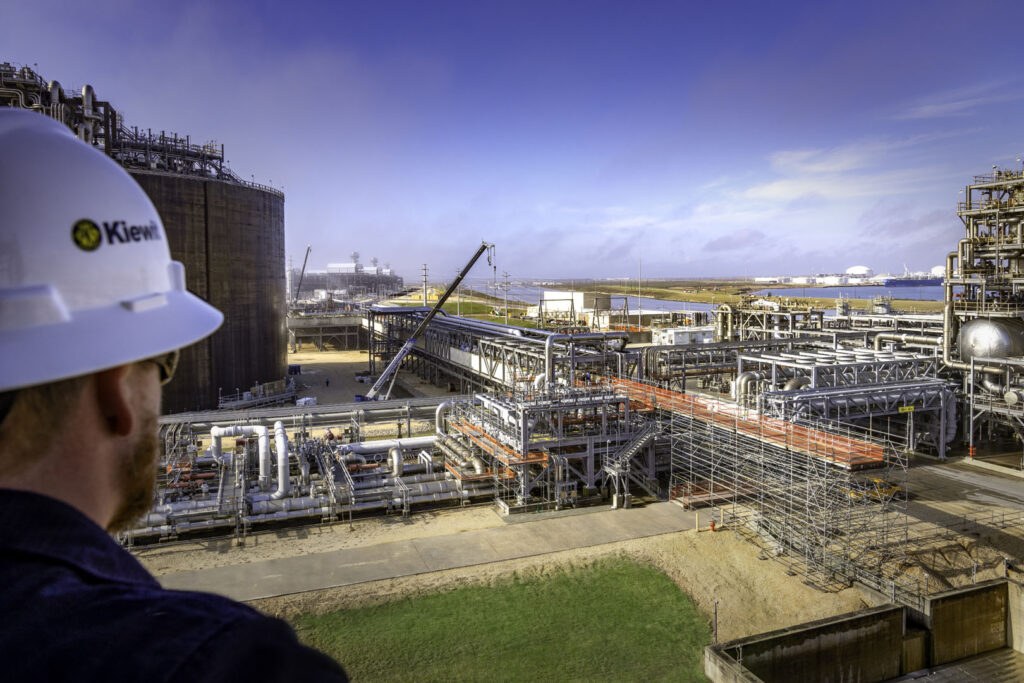
After an incident at Freeport LNG’s liquefaction facility shut down one of the country’s largest LNG export terminals in June 2022, Kiewit answered the call to quickly mobilize and help bring it back online.
That undertaking tested the relationship and Kiewit’s approach.
With intense pressure to get the facility back online under heightened regulatory scrutiny, safety and reliability were non-negotiable at every step.
“Without that partnership in place, the project could have unfolded very differently,” Ruiperez Vara said. “As new findings emerged from the investigation and regulatory review process, it was critical to have a partner like Kiewit who could adapt quickly, collaborate effectively and remain focused on the broader objectives.”
That success during the restoration effort has helped shape the partnership beyond construction. Today, front-end studies and engineering optimizations play an equally important role in helping Freeport LNG achieve its goals.
“Some of the highest return opportunities we’ve seen come from optimizing existing assets,” Ruiperez Vara said. “Debottlenecking, reliability improvements and operational optimization can unlock meaningful production gains while requiring significantly less capital than new infrastructure.”
Identifying those opportunities is only the starting point. According to Kiewit Energy Group Senior Vice President Brad Kaufman, Kiewit’s ability to drive successful outcomes means keeping the owner’s long-term interest in mind by translating engineering insights into practical solutions that can be carried through execution.
“We’re fortunate to work with owners like Freeport LNG who value collaboration, transparency and long-term thinking,” Kaufman added. “That kind of partnership allows us to ensure the focus goes beyond engineering or front-end studies to ensure a practical, bankable path forward. That means not only reducing risk and strengthening the economics but ultimately developing a solution that can be executed in the field.”
For Neus, getting the most value out of any project, whether it’s a major capital project or an existing asset optimization, requires a holistic perspective.
“Value isn’t just the cheapest project. In fact, rarely is it the cheapest project,” Neus said. “It’s something that bears out over time. At the end of the day, you want a safe and efficient facility that you can depend on for secure operations.”